The ceremonies and traditions of the Omo Valley tribes are among the most ancient and authentically preserved cultural practices remaining in the world today. While much of Africa’s traditional heritage has been transformed by colonialism, urbanisation, and globalisation, the remote Omo Valley has remained a stronghold of living traditions that stretch back centuries — in some cases, millennia. Understanding the significance of these ceremonies enriches any visit immeasurably and transforms casual observation into genuine cultural understanding.
Hamer Bull-Jumping (Ukuli Bula)
The bull-jumping ceremony is the most important rite of passage in Hamer society and arguably the most famous tribal ceremony in all of Ethiopia. When a young Hamer man reaches maturity — typically between ages 17 and 25 — his family announces that he will undergo the Ukuli Bula. The preparation takes days, sometimes weeks, as family and friends gather from across the region. Cattle are selected and castrated, women prepare ceremonial food and honey wine, and the community buzzes with anticipation.
On the day of the ceremony, 15 to 30 castrated cattle are lined up side by side, held steady by experienced men. The initiate strips completely naked, and must run across the backs of the cattle — from one end to the other and back — four times without falling. If he succeeds, he becomes a Maz — a full adult member of the community who may now marry. If he falls, he must wait and try again at a later ceremony. The crowd erupts in song and celebration as the young man completes his final pass.
Perhaps the most controversial aspect of the ceremony is the whipping that precedes it. Female relatives of the initiate voluntarily present themselves to be whipped by Maz (men who have already passed the test) using thin wooden switches. The women blow horns to taunt the men into striking harder, and the resulting welts are worn as symbols of devotion and loyalty to the initiate. This practice, while jarring to outside observers, is deeply meaningful within Hamer culture — the women take pride in their scars, which represent an unbreakable bond.
Mursi Lip Plates (Dhebi a Tugoin)
The Mursi women’s clay lip plates are perhaps the single most iconic image associated with the Omo Valley. The process begins when a girl reaches 15 or 16 years of age. Her mother or another elder woman makes a small incision in the lower lip and inserts a wooden peg. Over the following months, progressively larger clay discs are inserted to gradually stretch the lip. The final plate can reach 12 centimetres or more in diameter.
Contrary to popular belief, wearing a lip plate is a personal choice — not all Mursi women choose to undergo the process. Historically, the size of the plate was associated with bride price (the number of cattle a groom’s family would pay), but today the practice is more closely tied to cultural identity and personal aesthetics. The plates are removable and are typically worn during ceremonies, social gatherings, and meals. Mursi women also practise elaborate scarification — deliberately cutting the skin to create raised geometric patterns on their shoulders, arms, and torsos — as an additional form of body art and beauty.
Karo Body Painting
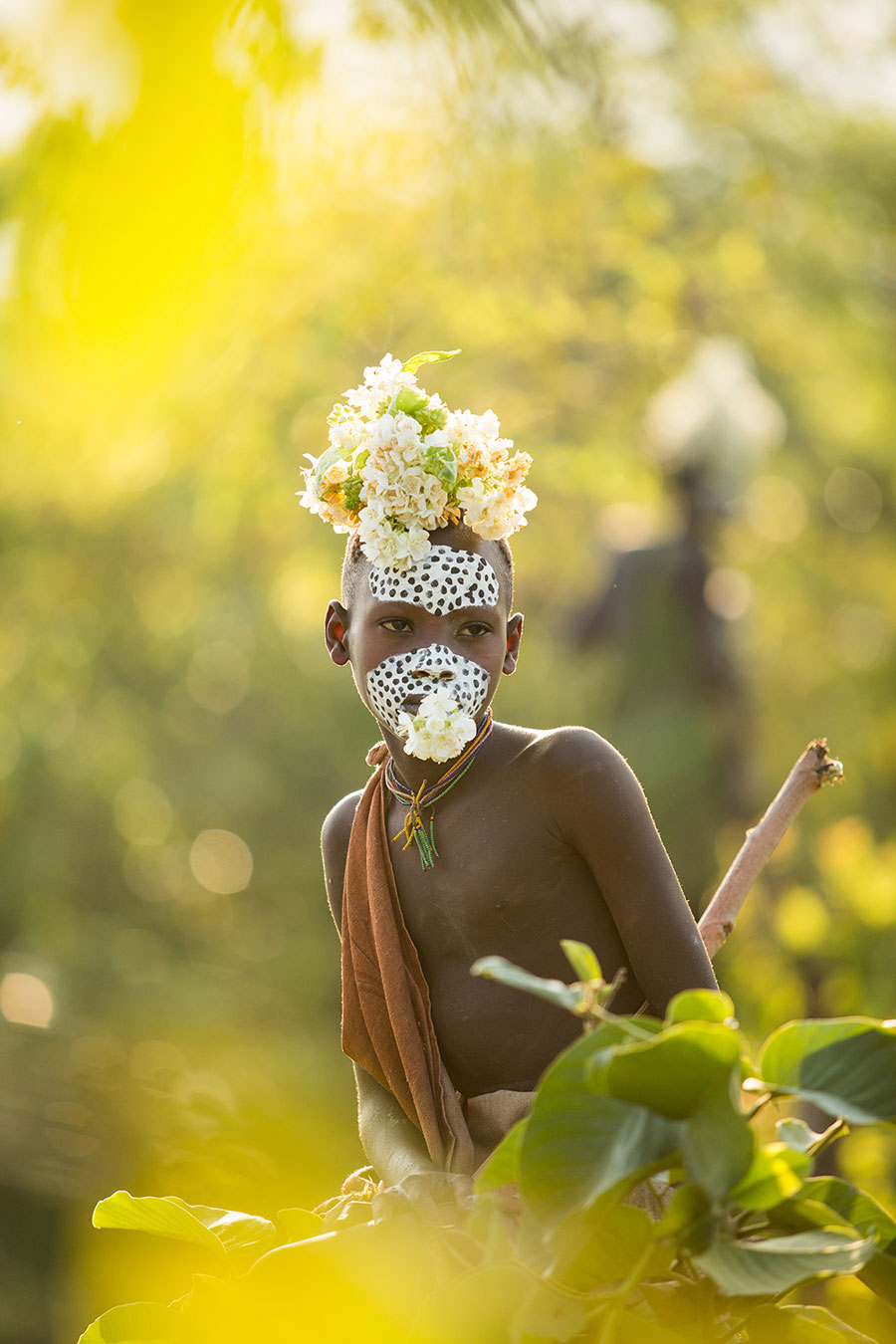
The Karo tribe — the smallest in the Omo Valley with a population of only 1,000 to 3,000 — are the valley’s most celebrated body painters. Using white chalk (from crushed limestone), yellow mineral rock, charcoal, and red iron ore, the Karo create intricate designs on their faces, torsos, arms, and legs. The patterns are not random — they draw inspiration from the natural world, particularly the spotted plumage of guinea fowl, the stripes of zebras, and the dappled light filtering through acacia canopies.
Body painting serves multiple purposes in Karo society: celebration (for dances, ceremonies, and harvest festivals), attraction (young men paint themselves elaborately to impress potential partners), warfare (distinctive patterns identify warriors of different clans), and spiritual protection (certain designs are believed to ward off evil spirits and disease). The Karo also practise scarification, where men cut their chests to create raised patterns marking their achievements in hunting or combat.
Donga Stick Fighting (Mursi)
Donga is a ceremonial stick-fighting competition that holds immense social importance among the Mursi. Two teams of young men from different clans face off, each combatant wielding a 2-metre wooden pole called a donga. The fights are governed by rules — no striking a man who has fallen, no hitting below the knees, and the fight ends when one combatant is knocked down or concedes. Fighters sometimes wear protective padding made from cotton and animal hide, though serious injuries do occur. The victorious fighter is carried on the shoulders of his supporters and presented to eligible young women, who may choose him as a partner. Donga serves to settle inter-clan disputes, demonstrate personal courage, and provide a structured arena for young men to prove their worthiness.
Evangadi Night Dancing (Hamer)
The Evangadi is a Hamer nighttime dance ritual that serves as one of the primary social gatherings for young, unmarried men and women. As darkness falls, groups gather around a fire. The men leap high into the air in powerful, rhythmic jumps while the women clap, sing, and shuffle their feet in synchronised patterns. The dance is both athletic performance and courtship ritual — young men and women size each other up across the firelit circle, and relationships are formed through the shared intensity of the dance. The singing continues late into the night, the songs covering themes of love, longing, cattle, and the beauty of the Omo Valley landscape.
Visiting Ceremonies with Respect
If you are fortunate enough to witness a ceremony during your visit, remember that you are a guest at one of the most significant events in a person’s life. Follow your guide’s instructions about where to stand, when to photograph, and what areas are off-limits. Dress modestly — avoid revealing clothing. Do not interrupt or attempt to participate unless explicitly invited. And above all, remember that these are living traditions, not performances staged for tourists. They carry the weight of centuries of meaning and are being performed for the community — not for your camera.